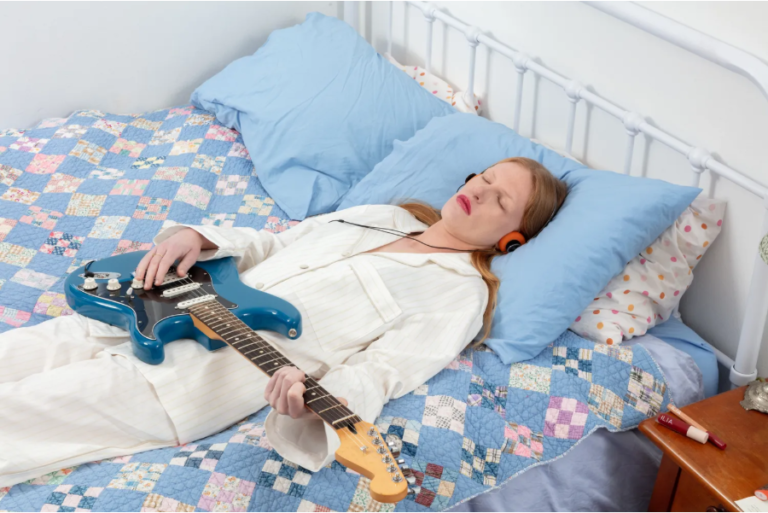
Twenty-six-year-old Audrey Hobert has sung about many things in her songs: Amazon Basics, Pilates, and that one line that has made countless people nod in agreement—”Acne is a bitch, but it goes away.” Her debut album, Who’s the Clown?, feels like a diary set to music—filled with the everyday experiences that Gen Z recognizes instantly, including the confusion and eventual reconciliation regarding one’s own face.
So, when Ilia Beauty reached out to collaborate, the partnership itself felt imbued with a sense of destiny. This wasn’t the standard script of a celebrity simply endorsing a brand; rather, it was the story of a girl who had once struggled with skin anxiety finally finding a brand that was born from that very same struggle.
I. From Sephora Shelves to the Vanity Table
Hobert’s connection with Ilia began during those afternoons spent browsing Sephora alone. “I’d walk into the store and feel like that brand really aligned with my values,” she says. For her, the focal point of any everyday makeup look has always been the lips—a swipe of lip gloss, or a touch of lip liner, is all it takes to make her feel “fun.”
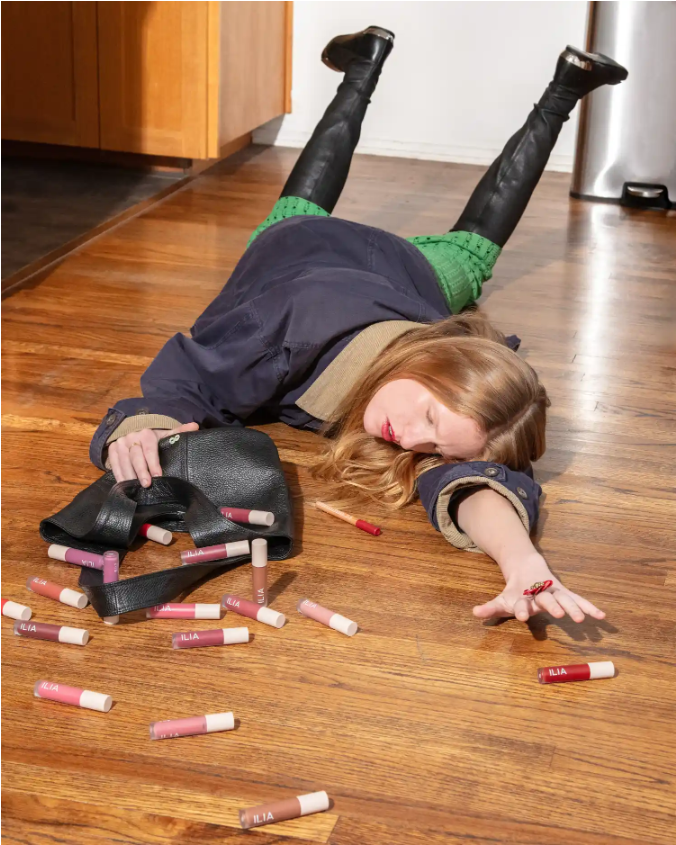
The collaborative set, priced at $52, features a new shade of the Overglaze Hydrating Lip Gloss (in “Studio,” a raspberry red) and a Lip Sketch Hydrating Crayon (in “Blue Note,” a cool-toned cherry red). It also includes a tote bag featuring the signatures of both parties. Ilia’s CMO, Liz Cebron, explained that Hobert was chosen because “her relationship with beauty is deeply personal”—she has sensitive skin, struggled with acne throughout her adolescence, and has even sung about these experiences in her music.
This narrative mirrors the story of Ilia’s founder, Sasha Plavsic: Plavsic, too, founded the brand precisely because she couldn’t find makeup products that didn’t irritate her skin. —
II. Phoebe: A Song About Faces
In the song Phoebe, Hobert sings: “I think I have a fucked-up face / This thought used to haunt me / Until I fell into its sweet embrace.”
When she wrote the song, she had just returned from her first “business trip” to New York—being wined and dined by record labels, experiencing that sense of unreality akin to a “Disney Channel Original Movie.” Upon returning home, she sat on her couch, then suddenly went upstairs to grab her guitar, and wrote the first verse and chorus.
The lyric about having a “fucked-up face” gave her pause. She called her father, who said, “I don’t like that line.” She called her sister, Ella; as she played the song for her, she watched her sister grimace. She slept on it and tried out other words, but ultimately decided to keep the original line. “I’ve said that to myself,” she wrote on Substack. “Even the most classically beautiful women in the world have said it to themselves. I might as well just say it out loud.”
This candor has become her trademark. While touring, when performing the song Wet Hair, she would often pause to talk about how comments regarding her appearance in school had affected her. But she eventually learned to separate other people’s opinions from reality. “If someone is looking at me, I’d rather they look right at my acne than watch me pretend I don’t have any,” she says.
III. The Long Journey from Full Glam to Bare-Faced
Hobert’s journey with makeup and beauty is a quintessential Gen Z coming-of-age story.
In elementary school, she loved dressing up elaborately every day; coordinating her outfits brought her joy—until someone mocked her for it, at which point she began dressing more casually. In middle school, she joined the dance team; on “pep rally” days, she would have to sit through her first-period class wearing full stage makeup—smoky eyes, red lipstick, and tightly slicked-back hair. “Nobody was fucking looking at me; it was so embarrassing,” she recalls.
Her skin miraculously cleared up in college, and she immediately stopped wearing makeup. She also went through a “brow journey”: using eyebrow pencils in middle school, visiting the Benefit BrowBar later on, and finally attempting a DIY brow tint in college—with disastrous results. “It’s not regret,” she says, “but looking back, I think: Your eyebrows are black.” Since the pandemic, she has completely given up on dyeing her brows.
Today, she has reached a state of total self-acceptance. “This is just how I look,” she says. If a breakout happens, she lets it happen. No concealing, no pretending.
IV. Color and Music: A Form of Synesthesia
Hobert’s visual world is saturated with primary colors—both her apartment and her music videos (Thirst Trap, Bowling Alley) reject muted, in-between shades. She has no use for maroon, teal, or burnt orange; she prefers only the classics: red, blue, and yellow.
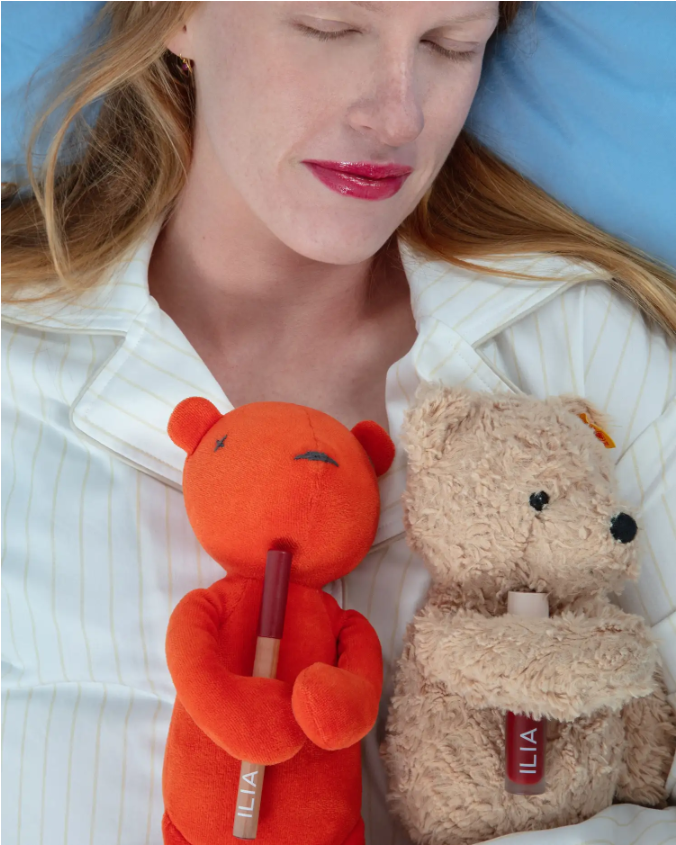
This color preference is also reflected in her collaboration with Ilia. She paired two products with specific songs: the lip liner corresponds to Shooting Star—”That song is about getting hyped up at the club, so I wanted a bold lip”; the lip gloss, when worn on its own, corresponds to Phoebe—”It makes me feel beautiful.”
V. Gracie Abrams: The Beauty Exchange Student
Hobert’s friendship with Gracie Abrams is one of the most closely watched partnerships in the pop music world. They not only collaborate creatively—Hobert co-wrote several tracks on Abrams’s album, The Secret of Us—but they also swap beauty products.
“Gracie is always showing me products; her makeup always looks so good,” Hobert says. She first discovered the highlighter combo stick thanks to Gracie. “Though I highly doubt I’ve ever shown her anything,” she adds with a laugh.
This asymmetrical exchange of knowledge perfectly illustrates their distinct roles in the realm of beauty: Gracie is the guide, while Audrey is the beneficiary. But when it comes to music, they are equal partners in crime.
VI. Touring and Makeup: A Centering Ritual
This summer, Hobert is hitting the road again for a tour. This time, she plans to apply a little makeup before taking the stage—not for anyone else, but for herself. “It helps me feel centered,” she says.
Her Ilia products will be coming along for the ride. For someone who works from home for extended periods—and occasionally needs to “put in a little effort” with her appearance to boost productivity—a lip gloss or a lip liner represents the most accessible form of self-care.
Audrey Hobert’s collaboration with Ilia is, at its core, a story about “authenticity.” Not the kind of authenticity airbrushed by filters, but the kind that sings about a “fucked up face”—the kind that acknowledges the reality of acne, and the kind that feels utterly mortified showing up to a first-period class in full makeup.
In an era where everyone is curating a picture-perfect lifestyle, her value lies precisely in her lack of polish. Ilia chose her not because she is perfect, but because she is imperfect—and that very imperfection is the face that resonates most deeply with Gen Z.
As she sings in her song: Acne is a bitch, but it will go away. And in the meantime? Put on some lip gloss, and keep on singing.