Emerald Fennell never makes “normal” movies. Saltburn proved that—every corner of that estate was steeped in a disquieting aesthetic, like an over-retouched oil painting. So when she announced she was making Wuthering Heights, no one expected a standard BBC-style period drama. Sure enough, the version she delivered came with a pair of quotation marks in the title: “Wuthering Heights”. This isn’t an adaptation; it is her retelling of a memory—a reconstruction of a world imagined through the eyes of a fourteen-year-old girl.
And in this world, hair and faces serve as extensions of emotion—externalizations of the characters’ inner states. Siân Miller, the artist responsible for bringing this to life—and a collaborator of Fennell’s on Saltburn—was tasked with creating a visual universe for Margot Robbie and Jacob Elordi that felt simultaneously familiar and alien.
I. Not a Period Drama, but a Fever Dream
From the very beginning, Miller understood that this would not be a traditional period adaptation. “Emerald was very clear from the start that this was being presented through the imagination of a fourteen-year-old girl—her own imagination,” Miller says. “It was obvious that it would be a fever dream.”
This meant no strict historical accuracy, and no dogmatic rules dictating “how people should have dressed in that era.” Instead, the aesthetic is a blend of mid-1950s melodrama and Victorian opulence, infused with fantastical elements. Miller’s mood board featured images from Pinterest, makeup looks created by Pat McGrath for John Galliano, Vivienne Westwood, and Alexander McQueen, as well as Surrealist art and brooding Gothic imagery.
She worked closely with production designer Suzie Davies (Saltburn, Conclave) and costume designer Jacqueline Durran (Anna Karenina, Little Women, Barbie) to ensure that every visual element felt cohesive to the audience.
II. Cathy’s Hair: From Wilderness to Cage
The evolution of Cathy’s hairstyle stands as one of the most sophisticated narrative tools in the entire film. The Wilderness Period: On the farm at Wuthering Heights, Cathy’s hair is untamed and disheveled—a symbol of her wild existence and a visual echo of her days running free across the moors.
The Manor Period: When she leaves home to reside at the manor with her husband and the Linton family, her hair becomes noticeably more controlled and sculptural. Even when worn loose, its texture is smoother and more defined.
The “Horns” of Triumph: In a pivotal scene where Cathy taunts Heathcliff upon his unexpected return, Miller designed a style for her featuring “triumph rolls” shaped like horns—a nod to her devilish behavior. Yet, to the audience, it resembles a crown, hinting at her role as an “evil queen.” “This is the moment she hardens,” Miller observes. “She becomes meaner, colder. It’s a much harsher silhouette.”
A Cage Beneath the Veil: One of Miller’s favorite looks appears in Cathy’s wedding scene—where, paradoxically, you cannot actually see her hair. It is completely obscured by a veil as she crosses the moors to marry Edgar Linton, despite her heart truly belonging to Heathcliff. However, Miller reveals the truth hidden beneath the veil: a lattice-like woven braid adorned with gemstones applied using a glue gun. “That lattice symbolizes her captivity: she is marrying Edgar, but she doesn’t truly want to,” Miller explains. “It is a metaphor for her being trapped.”
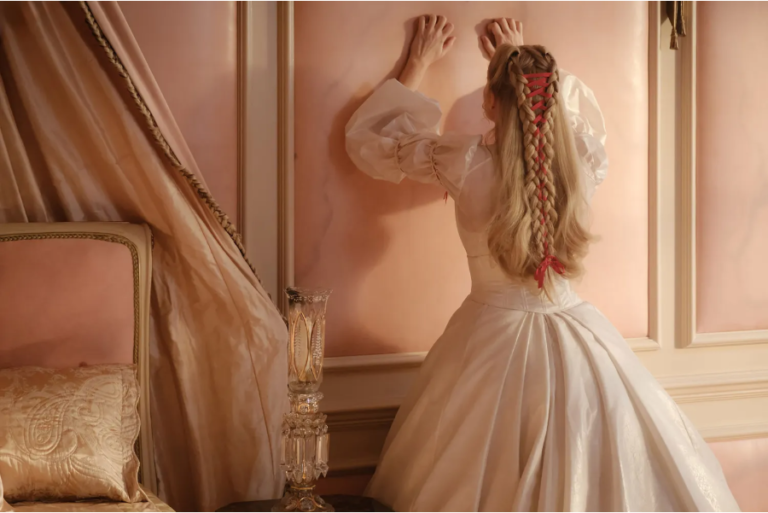
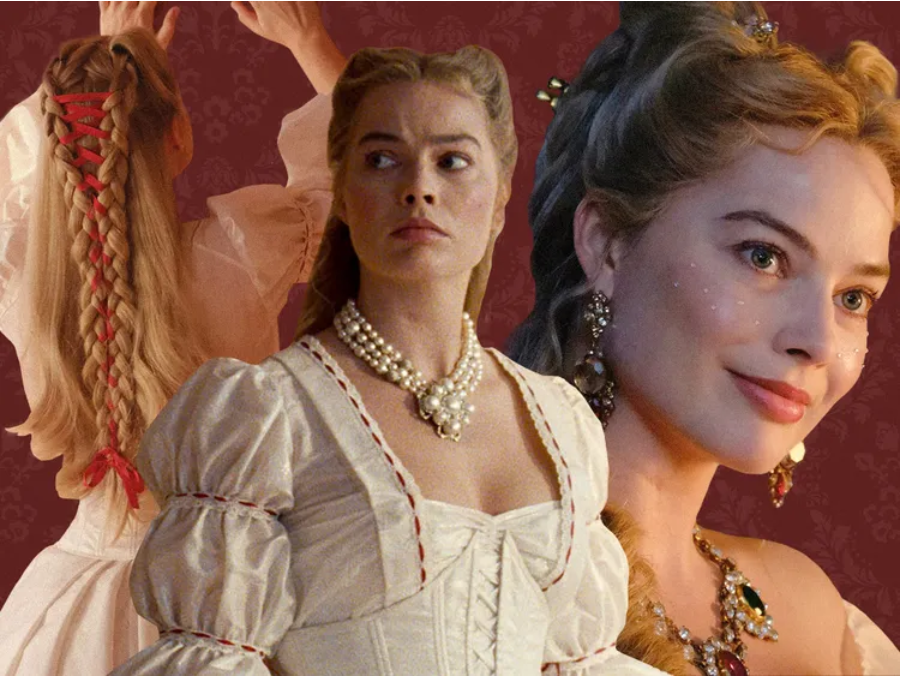
The “Doll Braids”: One of the most striking hairstyles—which I predict will be widely emulated—consists of a pair of twin braids interwoven with red ribbons, cinched tight at the ends like a corset. Cathy begins wearing this style shortly after moving into the manor. In the film, it is Isabella who braids her hair, treating Cathy as her own personal doll—in more ways than one. Miller has given this style a fitting nickname: “The Doll Braids.”
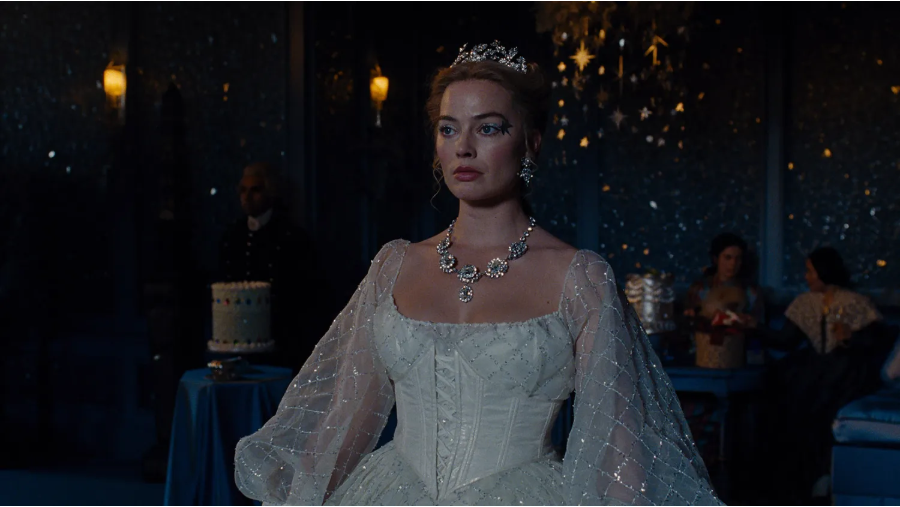
Finding the right shade of blonde and the perfect braiding style proved to be a challenge. The goal was to avoid drifting into the aesthetic territory of Game of Thrones or The Witcher—specifically, those icy-white blonde tones and warrior-style references. In the Wuthering Heights scenes, Robbie’s hair—specifically the strands framing her forehead—was achieved using a blend of hairpieces and extensions; for the scenes set at the manor, however, she wore a full wig.
III. Heathcliff’s Transformation: From the Wilds to “Mr. Darcy”
Jacob Elordi’s Heathcliff undergoes an equally dramatic transformation. Miller began with his own magnificent facial hair, which was later shaved down at a certain point, leaving behind only a pair of splendid sideburns—a look she knew she would have to replicate later, given that filming was scheduled to return to the desolate moorlands. To handle this task, she enlisted the help of Roberto Pastori, an exceptional makeup artist from Italy; not only was he more skilled at the job than she was, but he could execute it ten times faster.
The production strove to shoot the film as chronologically as possible—a true gift for both the actors and the styling team. Even so, the shooting schedule was rife with variables, particularly regarding Margot’s hair. As Miller notes, diving in blindly and spending hours on a look would have held up the entire crew. The key lay in problem-solving: how could they deliver the most dramatic transformations and the most stunning looks within the allotted time?
IV. Makeup: From “Sweat” to Silver Leaf
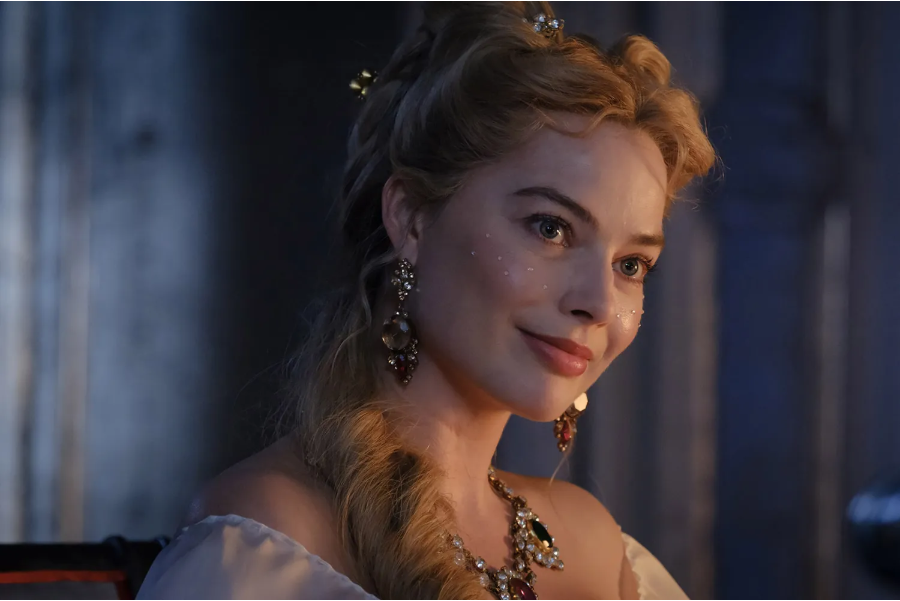
One of the film’s most modern looks was drawn directly from the set design. During a tense dinner scene following Heathcliff’s return—now a wealthy man who has entered what Miller describes as his “Mr. Darcy era”—Cathy’s hair is adorned with hairpins and combs that Miller had painstakingly embellished by hand. Her face is studded with gemstones inspired by the silver walls in the background, which themselves were embedded with clear, crystalline stones. “It was almost meant to look like sweat,” Miller explains.
The film also features a montage of makeup looks that you might miss if you blink: silver-leaf eyeshadow and black lips, inspired by Pinterest and the work of Pat McGrath.
Blush as a Character: Rosy cheeks function almost as a character in their own right throughout the film—everyone, including the men, sports some form of blush. “We wanted the characters in Wuthering Heights to have a weather-beaten look,” says Miller. “Jacob has it; the young Cathy and Heathcliff have it, too.”
For Cathy’s scenes at the Manor, Miller used Rare Beauty’s Soft Pinch Liquid Blush in shades “Hope” and “Happy,” along with Merit’s Flush Balm in “Après” and “Postmodern,” as well as Pat McGrath Labs’ Divine Cream Blush. For the scenes set at Wuthering Heights, she applied No. 1 de Chanel’s Lip and Cheek Balm in “Berry Boost.” Miller described Kylie Cosmetics’ Hybrid Blush in “Winter Kissed” as the “perfect doll-like pink” used on Isabella.
Cathy’s lip color alternated between Burt’s Bees Tinted Lip Balm in “Rose” and a discontinued Kiehl’s Men’s Lip Balm—specifically to avoid any discernible lip line. For certain looks at the Manor, Robbie wore Charlotte Tilbury’s Matte Revolution Lipstick in “Pillow Talk.”
V. Nail Art: A History of Eggshells and Beetle Blood
Miller also researched and recreated historically accurate nail art—originally crafted using eggshells and beetle blood (though, naturally, no beetles were harmed during filming). This meticulous attention to detail permeates the entire visual design of the film.
Fennell’s Wuthering Heights is not a film about the past, but rather a film about how memory distorts the past. Miller’s hair and makeup designs serve as the visual embodiment of this distortion—melding 1950s melodrama, Victorian opulence, and surrealist fantasy into the fever dream of a fourteen-year-old girl.
In this world, hair is not merely an ornament; it is a cage, a crown, and a doll’s plaything. Faces are not merely faces; they are maps of emotion—canvases for silver leaf and black-painted lips. Every look tells a story, and the audience’s task—amidst this visual feast—is to discern the hidden emotional truths lying beneath the surface.
Perhaps this is the most captivating aspect of Fennell’s film: it does not attempt to faithfully recreate Brontë’s work, but rather attempts to recreate the sensation of reading Brontë for the very first time—that fever dream of passion, anguish, confusion, and a certain indefinable beauty. And Miller—with her hairspray, gemstones, silver foil, and blush—transformed this feeling into a visible reality.